
Verified Backup Power, Built for Flexibility.
Turning digital landline resilience into auditable, grid-aware infrastructure.
Buffergy adds secure telemetry, battery health reporting, and reserve-aware control to broadband backup units, helping ISPs prove compliance while creating a pathway to local flexibility services.
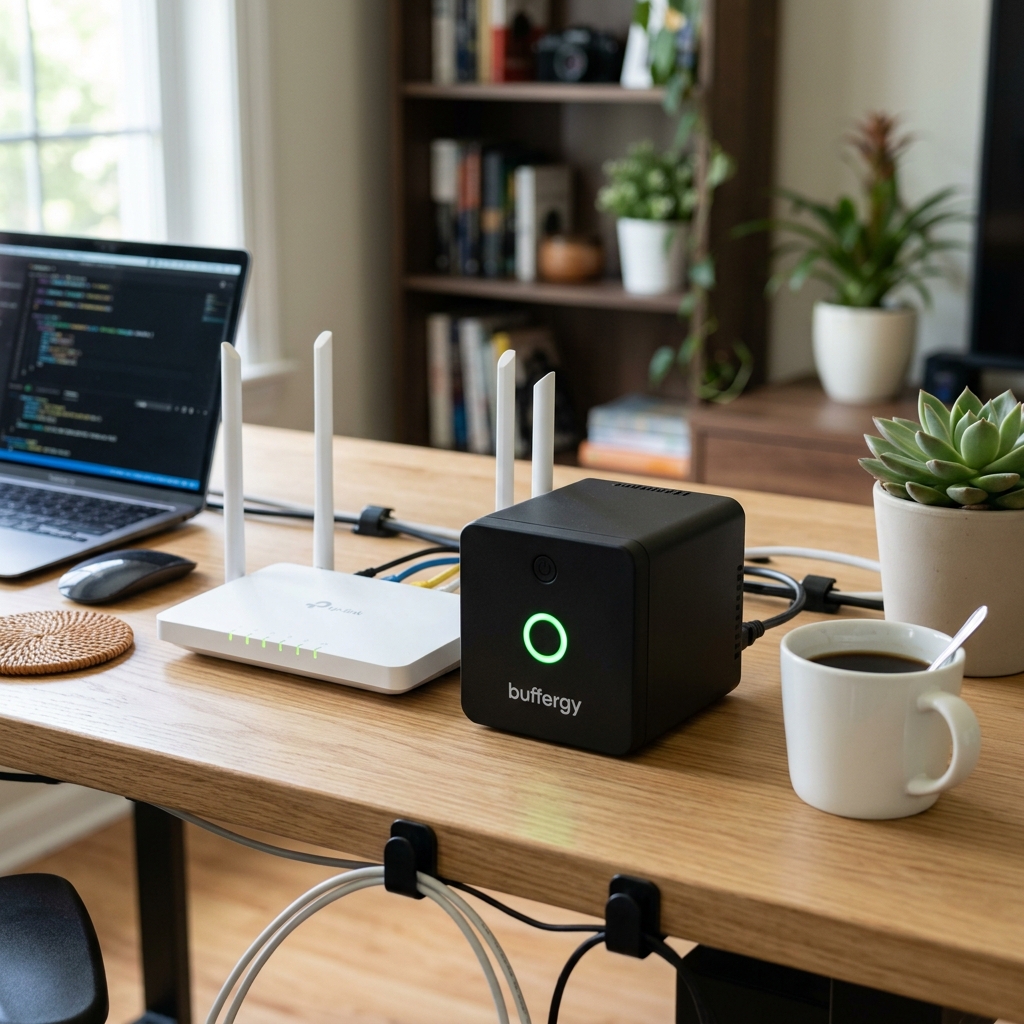 Edge Node (4" x 4")
Three Colliding Forces
Digital landline migration, customer resilience obligations, and local flexibility markets are converging at the same time.
Emergency Access Must Be Protected
Digital voice services rely on powered broadband equipment. Ofcom guidance expects providers to protect emergency calling during power cuts, including a minimum of one hour of resilience where a customer needs it.
PSTN Switch-Off Is Approaching
The UK's analogue landline network is expected to be retired by the end of January 2027. That creates a practical need for auditable backup power, remote diagnostics, and reliable customer support workflows.
DNOs Are Procuring Local Flex
Distribution networks already buy flexibility to manage congestion and defer reinforcement. Buffergy's opportunity is to make small domestic backup assets visible, measurable, and safe enough to consider in future local flexibility programmes.
Same Hardware. Now It Earns.
By adding a secure software layer to required backup batteries, we turn passive compliance hardware into measurable resilience infrastructure with a future flexibility option.
A Passive Sunk Cost of Compliance
In the standard compliance model, the regulator demands backup power. The ISP pays the full hardware cost, shipping a passive battery unit that sits in a corner of the customer's home.
- ✕ £30 per unit: 100% funded by the ISP's compliance budget.
- ✕ 0% Telemetry: No battery health reporting, no remote diagnostics.
- ✕ No Grid Value: Device sits completely idle, earning £0/yr.
- ✕ Single Benefit: Only protects the user during rare local blackouts.
Telemetry First. Flexibility Second.
Buffergy adds a secure telemetry and control layer to compatible BBUs, enabling battery health reporting, outage readiness, and carefully bounded flexibility events that never compromise emergency reserve.
- ✓ Lower Compliance Risk: Remote evidence of battery presence, health, and self-test status.
- ✓ Real-time Telemetry: Remote health, charge level, and active outage indicators.
- ✓ Reserve-Aware Flex: Flexibility is only made available above a protected emergency threshold.
- ✓ Granular Insight: Aggregated postcode-sector views help DNOs understand where domestic resilience capacity exists.
Reserve-Aware Flexibility Simulator
Model how an aggregated BBU fleet could expose limited flexibility while keeping emergency calling reserve protected.
Simulation Parameters
Adjust the modelled fleet size to estimate telemetry coverage and bounded flexibility headroom. Figures are illustrative and depend on device rating, reserve policy, and DNO programme design.
From Pilot Telemetry to Scaled Flexibility
The roadmap starts with proof, safety, and partner learning before scaling into wider domestic flexibility.
BBU Telemetry Pilot
Focus on the immediate digital landline resilience need: battery presence, charge state, self-test status, outage detection, and ISP audit reporting across a controlled regional pilot.
Reserve-Aware Flex Layer
Use pilot evidence to define dispatch limits, customer protections, telemetry SLAs, and DNO integration requirements before expanding into larger ISP and local-network deployments.
Broader Domestic Flex
Extend the same secure coordination model to compatible always-on home assets, smart appliances, solar inverters, EV chargers, and heat pumps once the compliance and safety model is proven.
The Software & Open Standard Spec
We publish the open hardware specification, meaning any manufacturer can build compatible units. We sell the secure central orchestration software.
Industrial Security
MQTT 5.0 transport encrypted end-to-end over TLS 1.3. Secure micro-controller architecture.
Utility-Grade Standards
Designed to align with IEC 61968/61970 interface concepts and PAS 1878/1879 demand-side response principles as the technical specification matures.
Vendor Agnostic
No vendor lock-in. Any local assembler can manufacture units utilizing the low-cost Buffergy chip.
Team & Traction
A dedicated founding team combining energy technology and scalable software systems.
Shaun Moore
FounderI am a completely self-taught engineer who has spent the last decade scaling technical platform architecture, grid orchestration protocols, and distributed energy systems.
Patrick Ogbuitepu
FounderLeading hardware spec design and embedded firmware. Expert in IoT device security, fingerprinting, low-power telemetry, and machine learning.

Ria
Office WooferA cocker spaniel dedicated to team morale, workspace security, and office snack verification. Always on standby to resolve stressful coding events.
Traction So Far
Innovate Suffolk Hackathon
Placed at the Hackathon, validating the technical and commercial premise against an industry and academic panel.
Prototype Unit Built & Tested
Built fully working bench prototype utilizing microcontrollers, LiFePO4 cells, custom relay controls, and remote telemetry shunts.
Regional Pilot Target
Preparing the evidence pack, technical specification, and partner proposal for an ISP/DNO pilot focused on resilience telemetry, battery health, and bounded local flexibility.
Collaborate to Innovate
Whether you represent a DNO seeking regional flexibility, an ISP looking to offset regulatory compliance cost, or an energy investor, let's connect.
Direct inquiries: partnerships@buffergy.uk